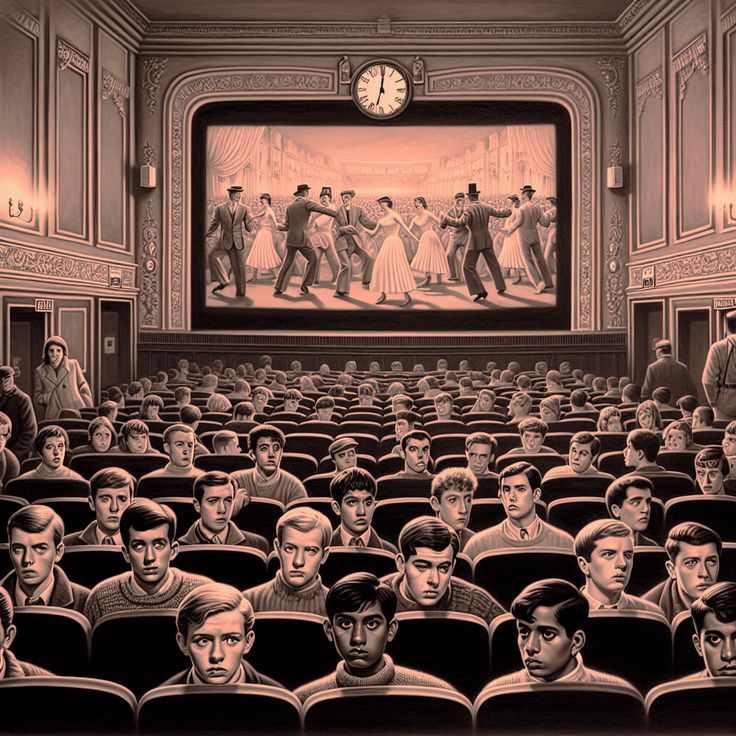
There’s a peculiar visual language that once dominated cinema but has now retreated into the realm of self-conscious homage and Looney Tunes cartoons. The iris shot—that circular mask that opens to reveal a scene or closes to end one—was once as essential to filmmaking as the cut itself. Then, almost overnight in cinematic terms, it disappeared. The question isn’t just why it vanished, but what we lost when it did.
The Grammar of Early Cinema
In the silent film era, the iris wasn’t a stylistic flourish. It was functional grammar, a form of punctuation that told audiences how to read a scene. An iris-in drew attention to a specific detail, acting as the camera’s equivalent of a pointed finger. An iris-out provided closure, a visual full stop that said “this chapter is complete” before the next one began.
D.W. Griffith, perhaps more than any other director, elevated the iris shot from mechanical necessity to artistic expression. In Intolerance (1916), Griffith used iris shots not just for transitions but as a philosophical tool. When the iris closed around Lillian Gish’s face in Broken Blossoms (1919), it wasn’t just ending a scene—it was isolating her suffering, forcing audiences to witness it without the context that might dilute its power.
The technique originated from a mechanical limitation: early cameras couldn’t easily cut between shots, and film stock was precious. The iris, created by adjustable metal blades inside the camera lens, offered an in-camera transition that required no editing. But as with many accidents of technology, this limitation birthed an artistic language.
The Psychological Power of the Circle
Why a circle? The iris shot mimics human vision more closely than any other transition. When we focus intently on something, our peripheral vision literally darkens—a phenomenon called “tunnel vision.” The iris shot replicates this cognitive narrowing, creating an intimacy between viewer and subject that a standard cut cannot achieve.
Consider the famous iris-out in Charlie Chaplin’s City Lights (1931), which closes on the Tramp’s face as he walks away after the flower girl recognizes him. The circular mask creates a literal spotlight effect, but more importantly, it creates temporal suspension. Unlike a cut, which implies immediate forward momentum, the iris-out allows for contemplation. It holds the emotional moment even as it visually releases it.
This psychological effect operates on multiple levels. The iris shot creates a sense of destiny or fate—as if the universe itself is focusing on or releasing this particular moment. It’s no coincidence that iris shots were prevalent during cinema’s most melodramatic era. The technique is inherently dramatic, even operatic.
The Sound Revolution
The iris shot’s decline began with the introduction of synchronized sound in the late 1920s. Suddenly, cinema had a new tool for directing attention: the human voice. Why use a visual technique to focus audience attention when a character’s dialogue or a musical cue could do the same work?
Moreover, sound films required more sophisticated editing techniques. The iris shot, which had served as a crude form of in-camera editing, became redundant. Why iris out of a scene when you could cut to the next one while maintaining audio continuity? The mechanical advantage that had made the iris essential now made it obsolete.
But there’s a deeper cultural shift at play. The iris shot belongs to a theatrical tradition—it’s essentially a circular stage curtain. As cinema moved away from its theatrical roots and developed its own unique grammar, techniques that emphasized cinema’s connection to theater fell out of favor. The iris shot began to feel old-fashioned, a relic of a more naive era.
Modern Homages and Misunderstandings
When contemporary directors use the iris shot, it’s almost always as homage or parody. The Coen Brothers iris out on Llewyn Davis carrying his guitar case through the snow, a visual joke that simultaneously mocks and mourns the character’s cyclical fate. Wes Anderson uses iris transitions in The Grand Budapest Hotel to signal the film’s self-conscious artificiality, its awareness of cinema history.
These uses are clever, but they’re essentially ironic. They assume the audience understands that the iris shot is “outdated” and will read its deployment as commentary on that outdatedness. This is fundamentally different from how Griffith or Chaplin used the technique—not as commentary on cinema itself, but as cinema’s most natural language.
Pixar occasionally employs iris-outs in their short films, but even these feel like affectionate nods to Looney Tunes rather than serious cinematography. The technique has become so associated with cartoons that its use in live-action drama would strike most contemporary audiences as comical, regardless of intent.
What We’ve Lost
The disappearance of the iris shot represents a broader loss in cinema’s visual vocabulary. Modern filmmaking has become increasingly uniform in its technical approach. With rare exceptions, films use the same basic arsenal of cuts, fades, and dissolves. We’ve gained sophistication in some areas—digital effects, for instance—but we’ve lost diversity in basic cinematic grammar.
The iris shot offered something that contemporary techniques cannot replicate: a sense of agency. When an iris closes on a scene, it feels like a conscious decision by the film itself, not just the filmmaker. The circular mask suggests an intelligence behind the camera making a choice about what matters and what doesn’t. Modern cuts feel mechanical by comparison—one thing happens, then another thing happens. The iris shot implied that someone, or something, was curating the experience for us.
There’s also a loss of rhythm. The iris shot operates at a different temporal speed than the cut. It creates breathing room, a moment of transition that allows audiences to emotionally process what they’ve just seen before moving to the next beat. Modern cinema’s addiction to rapid cutting has eliminated this contemplative space. Everything moves at the same breakneck pace, leaving no room for the kinds of emotional punctuation that the iris shot provided.
The Failed Revival
In the 1970s, during the New Hollywood era’s obsession with cinematic history, several directors attempted to revive the iris shot for serious purposes. Brian De Palma used it in Carrie (1976), but even there it felt like a reference rather than a natural choice. The technique had already been poisoned by association with the past.
The problem is cultural memory. For audiences who grew up in the 1950s and beyond, the iris shot was already outdated when they first encountered cinema. It arrived in their consciousness as something quaint, a marker of “old movies.” This makes its revival nearly impossible—it carries too much historical baggage.
Some experimental filmmakers have tried to reclaim the technique. Guy Maddin built an entire career on resurrecting silent film techniques, including liberal use of iris shots. But Maddin’s work is explicitly about cinematic archaeology. His iris shots are presented as artifacts, treasures recovered from a lost civilization, not as living techniques with contemporary relevance.
Technical Reasons for Extinction
Beyond cultural shifts, there are practical reasons the iris shot fell out of favor. Modern cameras and lenses aren’t designed to create iris effects easily. The adjustable aperture mechanisms that made the technique simple in early cameras have been replaced with different focusing systems. Creating an iris effect now requires post-production work—adding the circular mask in editing rather than capturing it in-camera.
This shift from in-camera to post-production effects has fundamentally changed filmmaking. When you must create an effect in-camera, it influences how you think about shooting. The iris shot forced directors to consider scene construction differently, knowing that attention would be focused or released in a circular pattern. Modern digital effects allow for anything to be added later, which paradoxically reduces creative constraint—and sometimes creative thinking.
The Circle’s Return?
Could the iris shot ever be rehabilitated? It seems unlikely. The technique is too firmly associated with cinema’s past to feel natural in contemporary contexts. But perhaps that’s the wrong question. Instead of asking whether the iris shot might return, we should ask: what techniques might we be developing now that will seem equally dated to future generations?
Every era of cinema develops techniques that feel inevitable, natural, and permanent. Then technology and culture shift, and these techniques become antiquated overnight. The iris shot’s disappearance reminds us that cinematic language isn’t fixed. It evolves, and in that evolution, we gain new possibilities while losing others.
The iris shot taught filmmakers to think in circles, to focus and release attention with geometric precision. We’ve replaced that circular thinking with rectangular frames and linear cuts. We’ve gained efficiency and a kind of transparency—modern editing doesn’t call attention to itself the way an iris shot inevitably does. But we’ve lost something too: a sense of cinema as a consciously curated dream, where an invisible intelligence guides our gaze through stories by opening and closing circles of light.
The Deeper Meaning
In the end, the iris shot’s disappearance isn’t just about a technical transition. It’s about how we understand cinema’s relationship to reality. The iris shot was honest about its artificiality. It never pretended to be showing us the world as it is—it showed us the world as seen through a focusing device, selected and shaped by artistic intention.
Modern cinema often strives for transparency, for the illusion that we’re not watching a constructed artifact but experiencing reality itself. The iris shot was a barrier to that illusion. It reminded audiences that they were watching a show, that someone was controlling what they saw. In our current era of invisible editing and naturalistic camerawork, such reminders feel like violations.
But maybe we need more reminders, not fewer. Maybe the iris shot’s greatest lesson isn’t about circular transitions—it’s about the honesty of artifice, about cinema that acknowledges it is cinema. In a media landscape increasingly obsessed with “authenticity” and “realism,” the iris shot stands as a monument to a different value: the beauty of consciously crafted illusion.
The circle isn’t gone. It’s just sleeping, waiting for the moment when cinema remembers that sometimes the most powerful way to show the truth is to frame it honestly as a story being told, with a beginning, a middle, and an ending marked by circles of light opening and closing like the eye of consciousness itself.
The next time you encounter an iris shot in a film, resist the urge to read it as mere nostalgia. Try to experience it as Griffith’s audiences did: as a natural focusing of attention, a breath between moments, a gentle insistence that this thing you’re seeing right now—this specific image in this specific frame—matters. Even if just for that moment, let the circle teach you to see differently.
Leave a Reply